Applied AI / Data architecture/Full-stack build notes // Vol 03
Nestly: Building a property assistant around listing data
How building Nia taught me to separate search, property data and conversation logic, and to give renters control over voice input.
Published
22 Nov 2026
Reading time
4 minutes
Written by
Abdulrahman Itseghosime Bello
Next.jsTypeScriptReactFull-stack developmentSystem architectureApplied AI
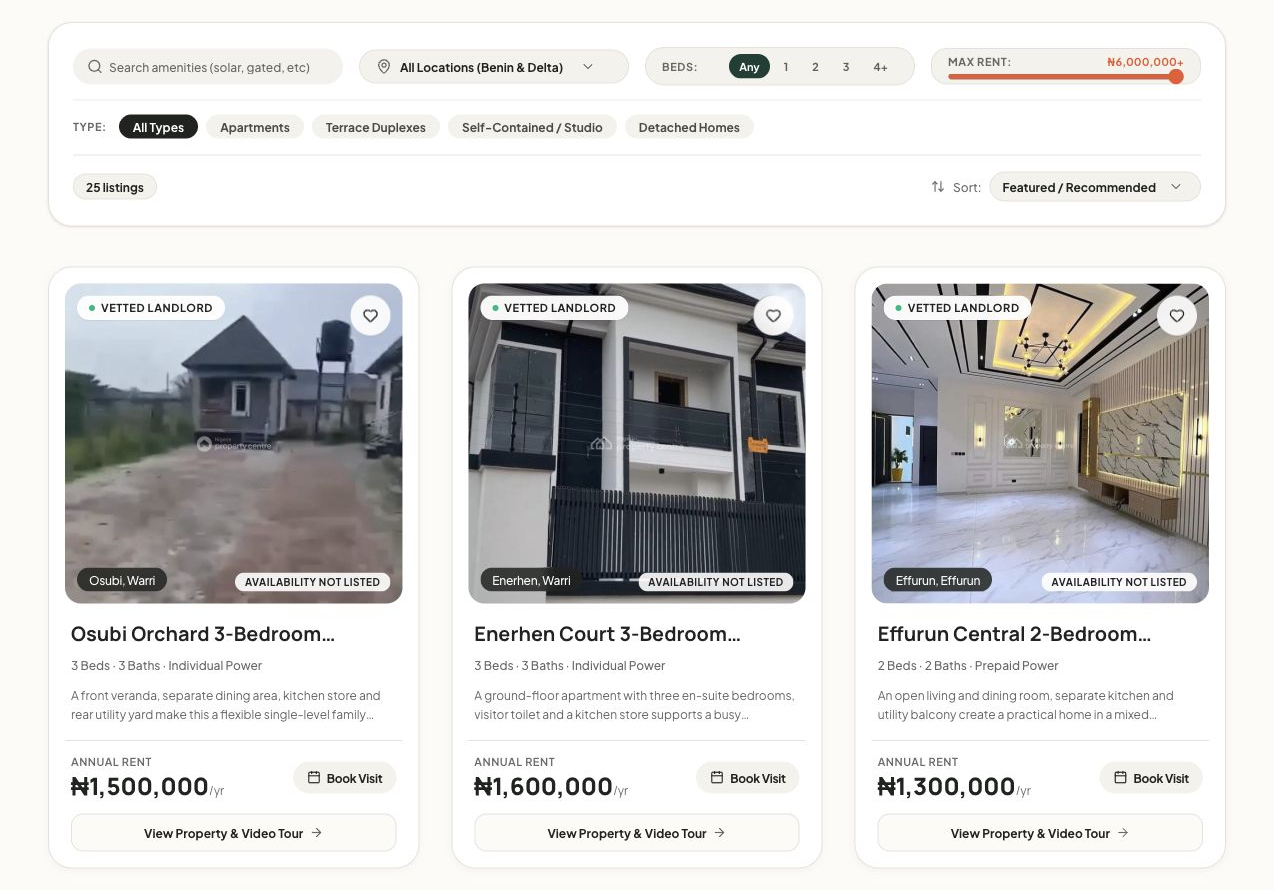
The browse view puts annual rent, location and availability labels alongside the search filters.
“Do you have a two-bedroom in Sapele with solar power?” sounds like a normal question. For a property assistant, it contains three different search criteria and a possible gap in the data. The assistant has to work out what to look for and what it can say if the listing leaves something out.
I built Nestly as a rental discovery prototype for Edo and Delta while developing my full-stack skills. It gave me a reason to think about how the interface, property database and conversation flow should work together. I handled the product direction, visual design and implementation, with AI assistance as I iterated on the interface and code. Nestly also gave me a chance to build an AI feature of my own: Nia, the property assistant.
Start with the listing
The browse page gives renters controls for location, bedroom count, maximum rent, property type and amenities. Nia gives them another way to express the same search by typing a question beside the results.
For the Sapele example, the useful work is to identify the location and room count, look up matching properties and see whether any record mentions solar power. The listing supplies the evidence. If availability is missing, the interface already has language for that: “Availability not listed.” That is a detail I want the chat experience to respect as well.
Building this made me think about the assistant as a series of decisions. What is the renter asking? Which criteria can the search apply? Which details does the record actually support? Those questions are easier to investigate than a broad complaint that an answer sounds wrong.
Give each part of the system a clear job
The Next.js interface gives renters two ways to start: use the browse controls or write a question to Nia. The backend lookup applies explicit criteria to property records, with Supabase supporting the application’s data layer. Nia can then use the records returned by the lookup to answer in plain language.
Separating those jobs gives me somewhere to start when something goes wrong. If a renter gets irrelevant properties, I can inspect the selected criteria and what the lookup returned. If the right records came back but the answer added an unsupported detail, I can focus on how the conversation handler used those records. That is a more practical debugging process than changing a prompt and hoping the whole flow improves.
Let the renter check the words before sending
Place names and amounts are easy to mishear. That matters when a single word or digit can change a property search. In Nia’s voice flow, the renter can speak, stop, review or edit the transcript, and then send it. The transcript goes into the message field, where it can be corrected like any other draft.
This is a small interaction, but I like what it does for the person using it. They can see what the browser heard before it becomes part of the conversation. Nestly does not save the audio. The browser may process speech online.
That helped me think more carefully about what a useful AI interaction looks like. Giving someone a chance to change the input can be as important as improving the answer.
Keep the conversation useful when a person joins
There are questions a listing cannot settle. A renter might need confirmation before making a viewing arrangement. The staff side of Nestly is where I’m working through that follow-up.
One question I’m still exploring is how much context a staff member needs when taking over a conversation. They should be able to see what the renter asked and what information was already shared. Otherwise, the renter has to start again. The full website and Telegram handoff still needs end-to-end verification.
Nestly gave me practice on both sides of AI: using an assistant to develop software and building an assistant into a product. The work I’m carrying forward is deciding where the data comes from, where a rule belongs, and how I can inspect each part before I trust the whole flow.