LAB 002 // Developer tools
Web Launch Auditor
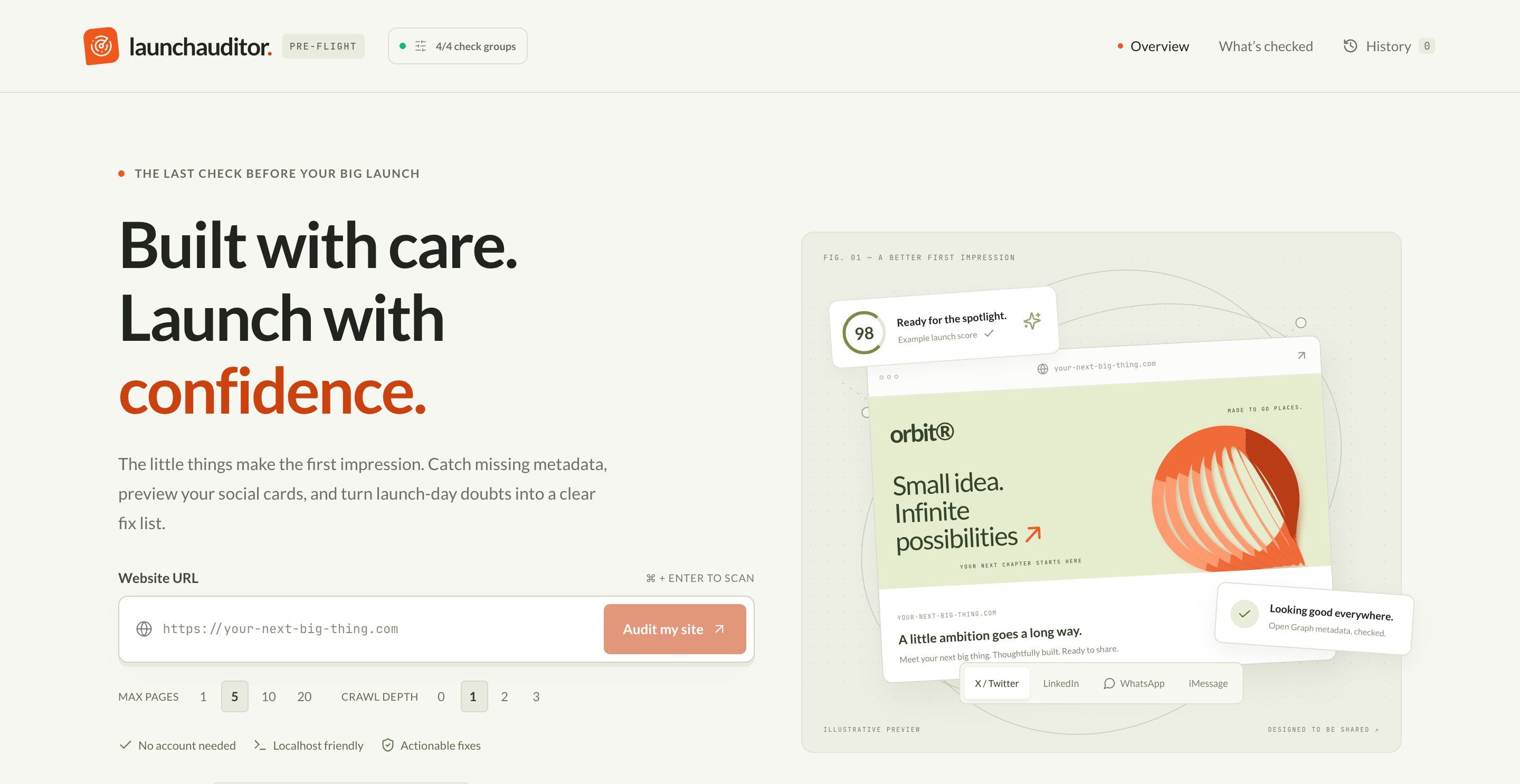
An in-progress website auditing tool that combines a Python CLI, a Next.js dashboard and a FastAPI service to surface page-level evidence and practical fixes.
- Category
- Developer tools
- Status
- Active experiment
- Version
- MVP
- Year
- 2026
The question
How can a bounded website audit turn technical launch checks into clear evidence and practical next steps?
Experiment log
Why I started it
I began Web Launch Auditor as a Python command-line project for checking website readiness. The goal is to make common launch checks easier to run and understand, with findings tied to the page and evidence that produced them.
What it checks
The auditor covers page titles and descriptions, heading structure, image alternative text, canonical URLs and Open Graph metadata. It also discovers internal links and can crawl a bounded set of pages so the report can show findings in context.
How the project is structured
The project has grown from the Python CLI into a Next.js scanning and results interface backed by a Python FastAPI service. SQLite provides persistence for scan queue and history. The interface communicates scan progress and gives users results to review, with JSON export for downstream use.
Bounded and cautious crawling
Crawl size and depth are configurable and limited. The fetch path includes public-address validation, DNS-pinned connections, response-size limits and a request deadline; crawls respect robots.txt. These safeguards are part of the tool’s current design, not a claim of a completed security certification.
Current status
Web Launch Auditor is an in-progress MVP in a public GitHub repository. It has no public deployment, and I’m continuing to develop and verify the frontend and backend. The repository is the source for the current implementation.
Findings & lessons
- 01
Start with a focused CLI
The first version made common website checks runnable from Python and established the audit logic before the interface work.
- 02
Give findings page-level context
A useful recommendation identifies the page and check behind it, so a developer can inspect the evidence before changing the site.
- 03
Bound crawl work
Page-count and depth limits help keep scans predictable and make the scope of a report clear.
- 04
Show work in progress
Queued, scanning and completed states help users understand what the service is doing and when results are ready.
- 05
Treat target fetching as a security boundary
Public-address validation, pinned connections, size limits, deadlines and robots.txt handling reduce risks associated with fetching user-supplied URLs.
- 06
Keep claims aligned with release status
The project is still an MVP and has no public deployment, so this entry describes implemented scope without presenting it as a launched service.